
You’re in the filter aisle. Your size comes in MERV 8, MERV 11 and MERV 13, and the price climbs with the number. The natural move is to buy the highest one you can justify.
Buying the highest number isn’t always right. A dense filter can starve some systems of air. For most homes a rating between MERV 8 and 13 is the sensible range. The right number is the highest one your system can move air through comfortably, and most of this article is about how to find where that is.
What is a MERV rating?
MERV stands for Minimum Efficiency Reporting Value. It comes from ASHRAE Standard 52.2, Method of Testing General Ventilation Air-Cleaning Devices for Removal Efficiency by Particle Size. ASHRAE is the engineering society behind most US heating and cooling standards, and it posts read-only copies of 52.2 if you want to see the test itself.
The test loads a filter with dust in stages and, at each stage, measures how much of the passing particles it stops. Particles are sorted into size bands, and the rating is built from the filter’s weakest results. That’s the “minimum” in the name. A MERV number tells you how a filter does on a bad day, not a good one.
The EPA’s explainer keeps it short: ratings run from 1 to 16, the test covers particles between 0.3 and 10 microns, and a higher number means the filter traps more of them.
What MERV leaves out is how hard the filter is to push air through. That’s a separate figure, and for a home system it matters about as much as the rating does. More on it below.
A rough MERV rating chart
The bands in this table are loose. Filter makers group them a little differently, and the standard itself reports capture efficiency by particle size, not a list of household nuisances. Treat it as orientation.
| MERV | Mostly aimed at | Where you’ll see it |
|---|---|---|
| 1 to 4 | Lint, carpet fibers, big dust | Flat fiberglass throwaways |
| 5 to 8 | Everyday dust, pollen, mold spores | Standard pleated home filters |
| 9 to 12 | Finer dust and more of the small stuff | Better pleated home filters |
| 13 to 16 | A much larger share of fine particles, smoke included | Media filters, hospitals, commercial buildings |
Past 16 you’re into HEPA, which is a different test entirely and something a typical home furnace isn’t built to push air through.
MERV 8 vs MERV 13
A MERV 8 filter catches most of what you’d otherwise wipe off the furniture, including pollen, household dust and the larger bits of pet dander. For a lot of households that’s all the filter needs to do, and it does it without asking much of the blower.
MERV 13 goes after the fine particles that stay in the air, such as smoke and much of what cooking throws off. The price is denser media: more resistance to airflow from the first day, and a filter that fills up faster.
MERV 11 sits between them. Coming from MERV 8, it’s the smallest step up.
Can my system handle MERV 13?
Your furnace or air handler has a blower sized to move a certain amount of air through a certain amount of resistance. The ductwork uses up some of that budget, the coil some more, and the filter takes its share. A denser filter takes a bigger share. When the total runs past what the blower was designed for, less air moves through the house.
House age plays into this. In the Census Bureau’s 2024 American Community Survey, about six in ten New Jersey homes were built before 1980, and the median year built is 1971 (the year-built breakdown is table B25034). Many houses of that era have a furnace in the basement or a utility closet, ductwork extended over the decades, and one central return grille with a 1-inch filter slot behind it. Pulling a whole house’s air through one small opening leaves less of the budget for the filter.
What happens next depends on the equipment. With less air across the cooling coil, an air conditioner can let the coil get too cold and ice up. A furnace moving too little air runs its heat exchanger hotter, and a safety limit may shut the burner off early. Newer variable-speed blowers try to make up for the restriction by spinning faster, which works up to a point but uses more electricity and makes more noise. The damage builds slowly. Uneven rooms and longer run times usually show up first, and an AC that runs most of the summer gives a starved coil plenty of hours to ice.
Check the equipment’s paperwork
The model number is on the data plate, usually inside the blower compartment door. Look up the installation manual on the manufacturer’s site. Some manuals name a filter type or a maximum pressure drop for the filter. Many only list a filter size, not a rating limit, and then you move on to the box.
Read the resistance figure on the filter box
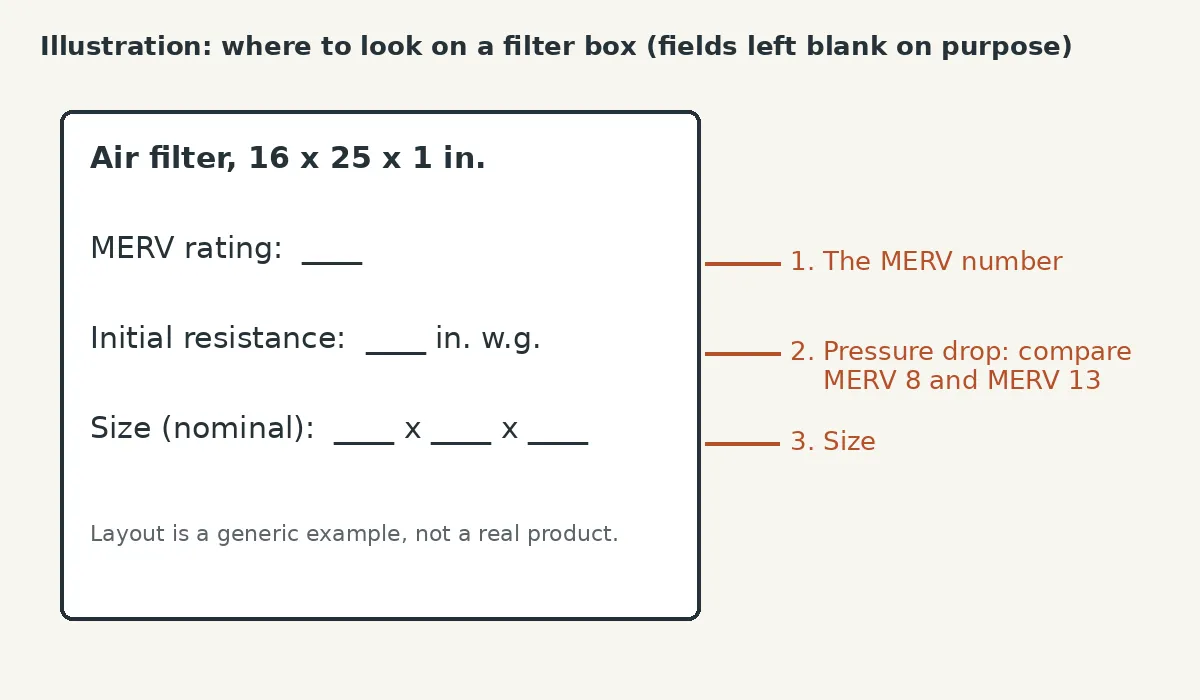
Many boxes print an “initial resistance” or “pressure drop” in inches of water column, and comparing the MERV 8 and MERV 13 of the same brand and size tells you more than the ratings do. A big jump between them is the warning.
Watch the system after you switch
If you try the higher rating, pay attention for a couple of weeks. The warning signs are weaker airflow at the vents, a whistle at the return grille, a filter that bows or gets sucked into its slot, rooms that take longer to reach temperature, and in summer, ice on the copper line at the outdoor unit. Any of those is a reason to step back down.
If none of that settles it, a technician can measure the system’s static pressure with a manometer, and that number is the real answer. Two identical furnaces on different duct systems can give different readings, and a house with one small return can be near the limit before any filter goes in. So there is no blanket yes for MERV 13.
1-inch filters vs 4-5 inch media filters
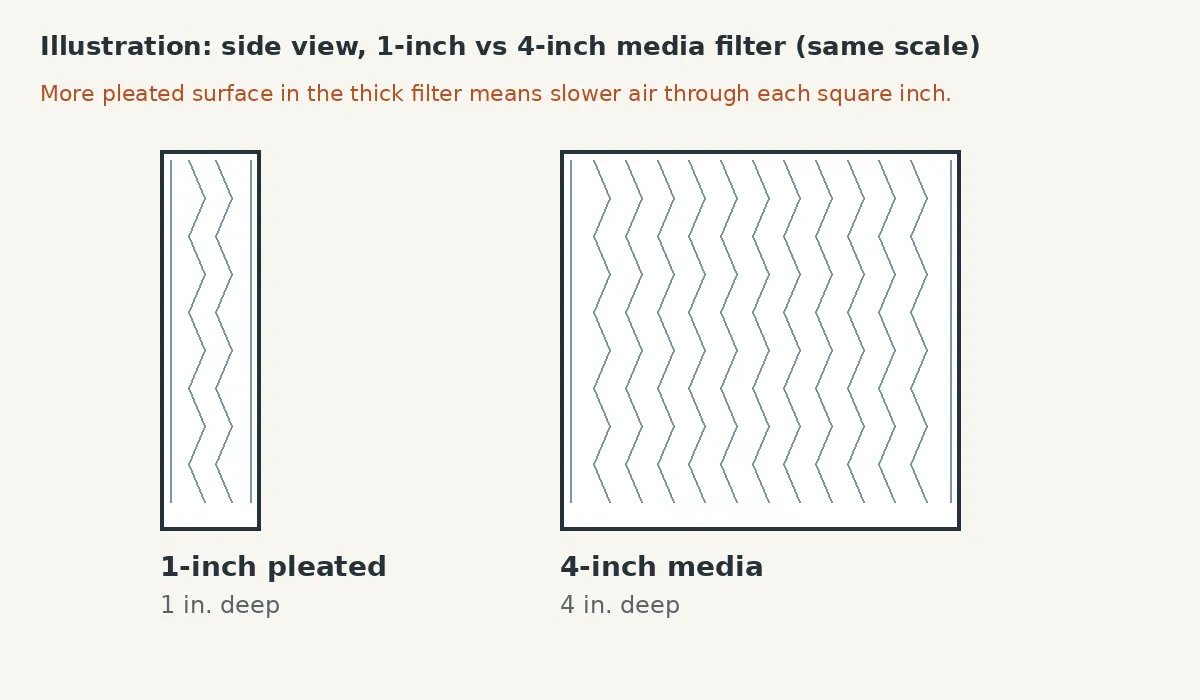
A 4 or 5 inch media filter packs far more pleated material into the airstream than a 1-inch filter. With more surface, the air passes through each square inch more slowly, so at the same MERV the thick filter restricts less and holds much more before it loads up.
That’s why “MERV 13” in a media cabinet and “MERV 13” in a 1-inch slot are not really the same purchase. If you want MERV 13 in the long run, the thick media filter is the lower-resistance way to get it.
The catch is that a media filter needs a cabinet built for it, fitted into the ductwork next to the furnace or air handler. You can’t put a 4-inch filter into a 1-inch slot. If your system already has one, you’re in good shape. If it doesn’t, that’s an equipment change, not a trip to the store. Thick filters also last longer between changes, and the maintenance guides cover schedules.
What MERV rating should I use?
For most homes the best MERV rating is 8 or 11. Here’s a plain way to decide in the aisle:
- On a flat fiberglass filter with no particular complaints? A pleated MERV 8 in the same size is an easy upgrade.
- On MERV 8, and someone in the house has allergies? Try MERV 11 in the same slot and watch for the signs above.
- Set on MERV 13 with a 1-inch slot? Check the manual and compare the box resistance first, and expect the filter to load up faster.
- Tempted by MERV 14 to 16? Skip it for a home system that wasn’t designed around it.
One aside from the aisle, since it trips people up: some boxes don’t show MERV at all. Some store brands use their own scales, such as FPR or MPR, instead of ASHRAE’s. There’s no official conversion, only charts each maker publishes for its own products, and you can decide how much weight to give a company grading its own work. If a box shows a MERV number somewhere, that’s the one to compare.
Fit matters too. A high-rated filter with a gap around the edge lets air skip past it, and air that goes around the filter isn’t being filtered at all.
The indoor air quality guides cover the other side of this, from basement air to humidity. If you have a question about your own system, you can reach our team through the contact page.