
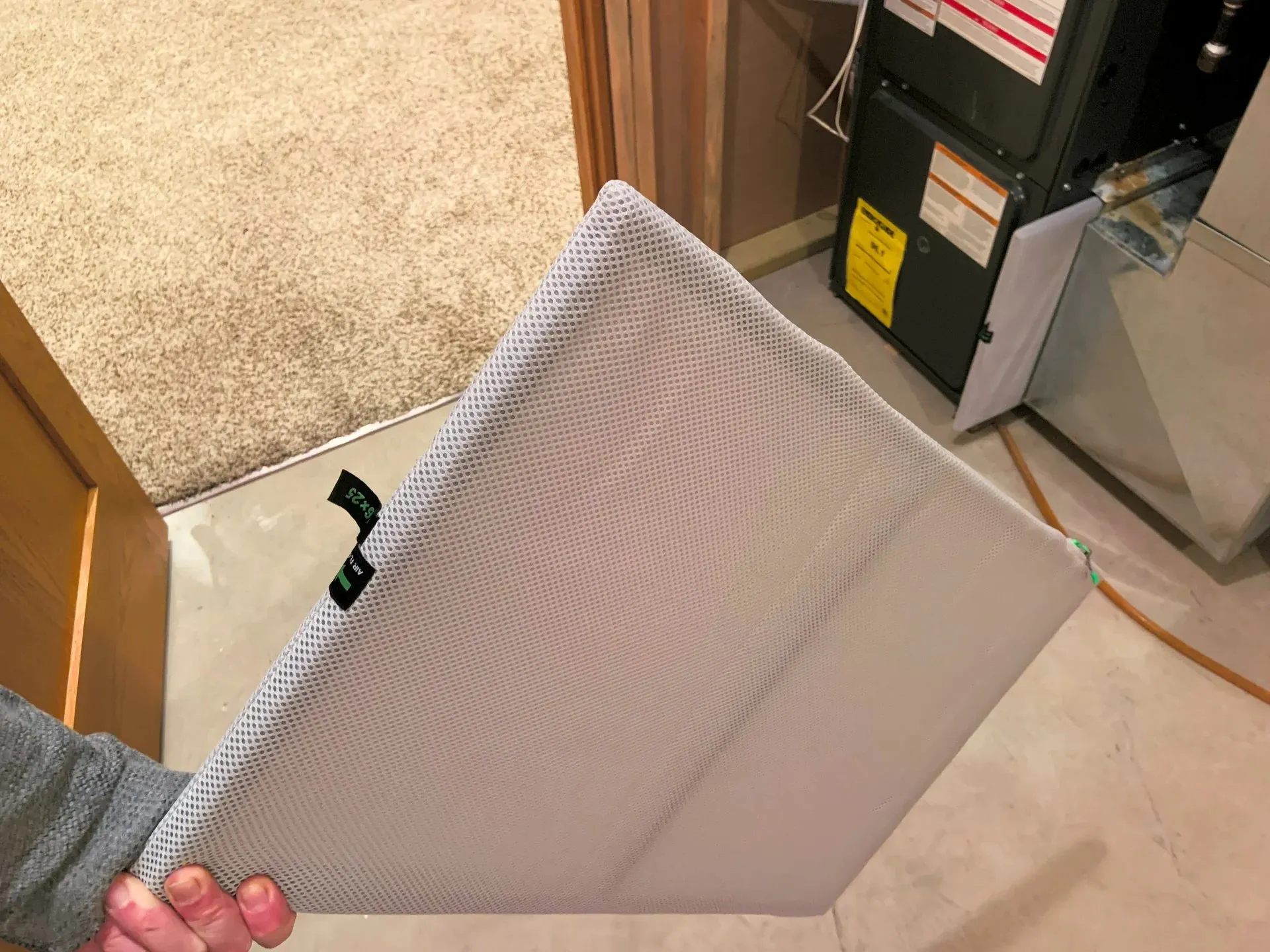
The size of your HVAC filter is almost always printed on the filter you already have, along one edge of the cardboard frame. So the short answer to how to tell HVAC filter size is: pull the old one out and read it. The rest of this guide is for when that doesn’t work, because the label is worn off, the slot is empty, or the numbers don’t seem to match anything.
Where is my furnace filter?
Start with the system switched off at the thermostat. You’re about to open something the blower pulls air through, and it’s easier with nothing moving.
Most homes keep the filter in one of two places, and which one you have usually follows from where the equipment is. In New Jersey a lot of furnaces sit in a basement, so the filter is often down there at the unit. Homes with a central return in a hallway wall or ceiling tend to hide a 1-inch filter behind that grille instead.
The first place is a return grille, the large slatted vent on a wall or ceiling where air goes back into the system. Some of these grilles swing open on a latch or a couple of thumbscrews, and a 1-inch filter sits right behind the slats. If yours opens and there’s a filter in there, that’s the one.
The second place is at the equipment itself: a slot in the side of the furnace, or in the air handler if you have a heat pump or a central air system with an indoor unit. Look where the big return duct meets the cabinet. There’s usually a thin cover or a door, sometimes just a strip of metal you slide sideways.
Then there’s the third arrangement, which trips people up: a separate metal box bolted between the return duct and the furnace, often in a utility closet, basement or crawlspace. That box is a filter cabinet, and it usually means a thick media filter, 4 or 5 inches deep. If you find one, skip ahead to the section on media filters before you buy anything.
A few houses have filters in more than one spot. If the return grille holds a filter and so does the furnace, both need replacing, and they may not be the same size.
Read the size printed on the frame
Once the filter is out, turn it so you can see the cardboard edge. You’ll find three numbers, width by height by depth, in inches: 16x25x1, 20x20x1, 20x25x4, that kind of thing. That’s the size you order.
Some frames also carry a second, smaller set of numbers with fractions in them. Don’t let that throw you. The big round numbers are the nominal size, and the small print is the actual size. Order by the big numbers.
Before the old filter goes in the trash, take a photo of that edge with your phone. It costs nothing, and the next time you’re standing in a store aisle wondering whether it was 16x25 or 16x20, you’ll have the answer. In a New Jersey house the same filter usually works through a heating season and then a humid summer of air conditioning, so that photo gets used more than once a year.
Nominal vs actual filter size
Filters are made a little smaller than the size printed on them, on purpose, so they slide into the slot without binding. According to Filterbuy’s sizing guide, the actual size runs about 1/4 to 1/2 inch under the nominal size on each side. Their example is a 20x20x1 filter that really measures 19.5 x 19.5 x 0.75.
Depth works the same way. A “1-inch” filter is about 3/4 inch thick.
A 2x4 is really about 1.5 by 3.5 inches. Same habit.
In practice this only matters when you’re measuring. If you measure an old filter and get 19 1/2 by 24 1/2 by 3/4, you haven’t found a strange size. You’ve found a 20x25x1.
No label? Measure it
This is where most of the mistakes happen, so it’s worth doing slowly.
If you have the old filter but the print is gone, lay it flat and measure the short side, the long side and the thickness. Get each one to the nearest 1/8 inch. Then round each one to the nearest whole inch, and that’s your nominal size. A filter that measures 15 1/2 by 24 3/4 by 3/4 is a 16x25x1.
If there’s no filter at all, measure the empty slot instead. Filterbuy’s measuring guide says to measure the opening, round each dimension to the nearest whole inch, and not to go by the outside of the grille, since a grille’s outer frame is always larger than the filter behind it. Measure the depth of the slot too, because that’s the number people forget.
The same guide adds a caveat that’s easy to skip past. If your measurements land on real fractions, something like 17 1/2 or 22 1/4, rounding might not give you a filter that fits, and you may need a custom size. We’d add one more step before ordering anything odd: check the label on the furnace or air handler, or its manual, since some list the filter size the unit expects. Not all of them do, and on older equipment the sticker may be unreadable anyway. If you can’t find it, the slot measurement is what you have.
One small habit while the old filter is still in your hand: note which way the airflow arrow on the frame points, and put the new one in facing the same way.
Why a loose fit matters
A filter that’s too small for its slot leaves a gap around the edge, and air takes the easy path. It goes around the filter instead of through it, carrying the dust the filter was supposed to catch into the blower and the coil.
The EPA takes this seriously enough to write it into its Indoor airPLUS construction specifications for new homes (Version 1, Rev. 04, section 4.7): filter access panels should have a gasket or similar seal and “fit snugly against the exposed edge of the installed filter when closed to prevent bypass.” That’s a building standard, not a homeowner rule, but the idea carries over. A filter should sit snug, and the cover should close flat against it.
You’ll see figures online for how much air slips past a loose filter. We haven’t found one backed by a published test, so we’re not repeating them here. What you can do is simple: once the new filter is in, run a finger around the edges. If you can feel a gap you could slide a finger into, the size is wrong.
A filter jammed into a slot that’s too small is the opposite problem. If it bows or you have to bend the frame to get it in, stop and re-measure.
1-inch filter or 4-5 inch media filter
Most homes use 1-inch filters. They’re the thin pleated ones sold everywhere, and they fit in return grilles and the slots built into most furnaces.
A 4- or 5-inch media filter is a different animal. It’s thick, often with deep pleats in a sturdier frame, and it lives in that separate filter cabinet between the duct and the furnace. The two aren’t interchangeable. A 1-inch filter dropped into a 4-inch cabinet will slide around and leave the gaps described above, and a thick filter physically won’t go into a 1-inch slot. The cabinet decides.
Depth is where people get it wrong. Filterbuy calls depth the dimension most people forget, and it’s easy to see why: 20x25x1 and 20x25x4 look identical on a list. On Filterbuy’s table a 1-inch filter is really about 3/4 inch deep and a 5-inch about 4 3/4. We’d still order a thick filter by what’s printed on the old one rather than by a tape measure, since a quarter inch either way decides whether the cabinet door closes. Some media cabinets are also built around their own maker’s filter, so while you’re there, write down the brand and model on the cabinet door.
If you’re weighing thicker filtration for allergies or dust, that’s a bigger question than size, and our indoor air quality section is the place to start.
What to write down
Before you buy, you want four things on paper or in your phone:
- the nominal size, all three numbers, depth included
- where the filter sits (return grille, furnace slot, or filter cabinet)
- which way the airflow arrow points
- if it’s a media cabinet, the brand and model on the cabinet
As for how often to swap it, ENERGY STAR’s advice is to check your air filter once a month, and change it when it looks dirty.
More filter and upkeep articles live in the maintenance section.
Questions about your system? Contact our team.