
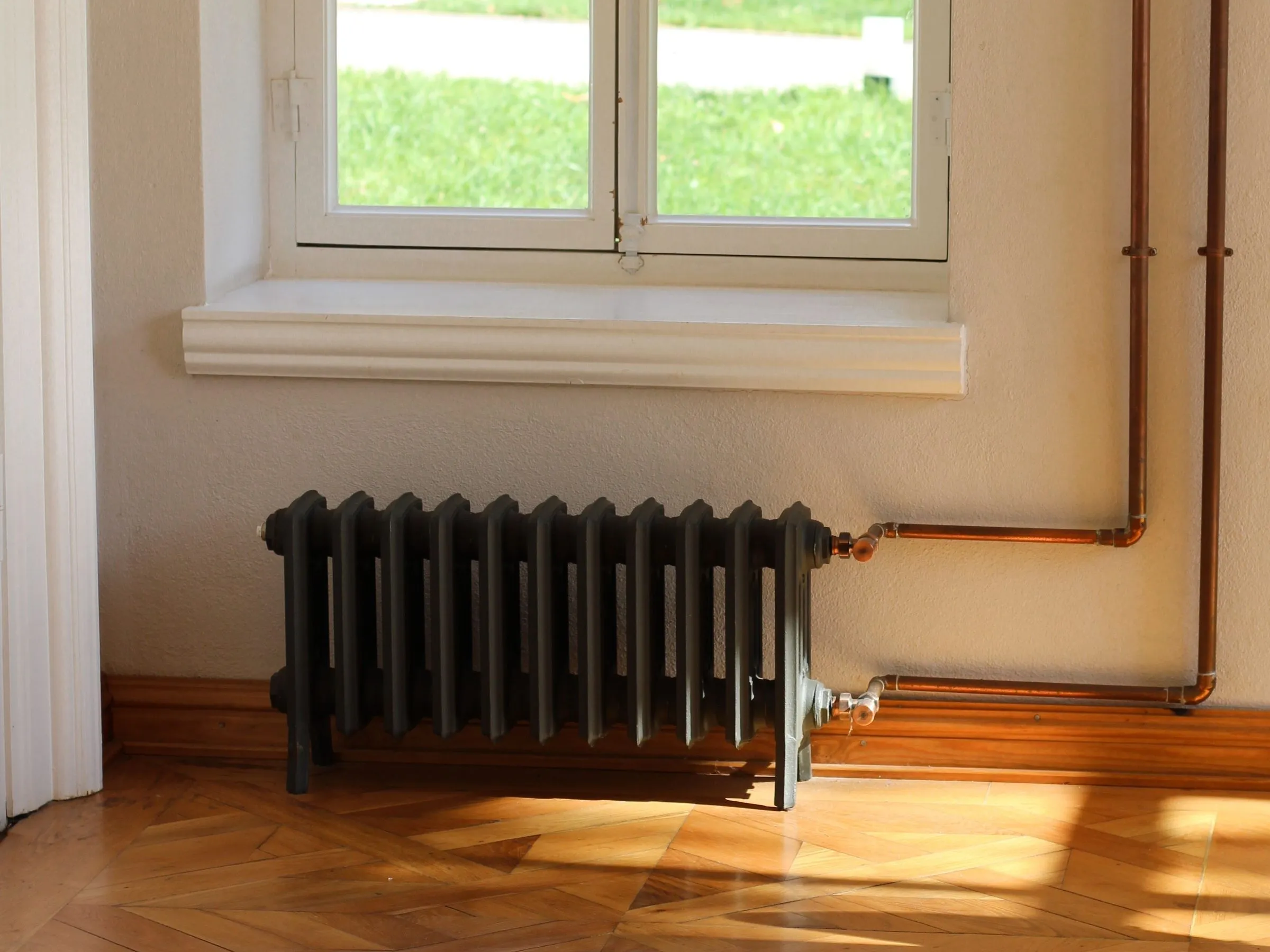
Both kinds of boiler do the same first job: they heat water. A hot water boiler pumps that water, warm but still liquid, through pipes to radiators or baseboards and back. A steam boiler keeps heating until the water boils, and the steam rises through the pipes on its own. Which one you have changes what wears out, what to keep an eye on and what your options are when the boiler gets old.
Steam boiler vs hot water boiler: how each works
Steam boilers and radiators
A steam boiler is only partly full of water. The burner brings that water to a boil, steam pushes up through the piping into the radiators, gives up its heat there and condenses back into water, which drains back down to the boiler. Nothing pumps it. Gravity and the pressure of the steam do the work, which is why steam piping is laid out with deliberate slopes and why a pipe that has sagged over the decades can cause banging.
The pressure involved is surprisingly low. According to Tameson’s guide to boiler pressure gauges, a residential steam gauge typically shows about 0.5 psi, and the controls cycle the boiler somewhere between 0.5 and 1 psi. A bicycle tire holds many times that.
Hot water (hydronic) boilers
A hot water system, often called hydronic heat, is full of water all the time: the boiler, the pipes and every radiator or baseboard. A circulator pump moves the water around the loop, and an expansion tank gives it somewhere to go as it heats up and expands. The same Tameson guide puts the operating pressure of most domestic hot water boilers at 1 to 2 bar, or about 14.5 to 29 psi.
Put the two side by side and the steam heat vs hot water heat difference is mostly about what moves the heat. On steam, the boiling does it, at barely any pressure. On hot water it’s a pump pushing a sealed, pressurised loop that runs cooler.
How can you tell if your boiler is steam or hot water?
You can usually answer this in a couple of minutes without touching anything. Look, don’t adjust: no valves, no drain cocks.
The sight glass
This is the most reliable clue. A steam boiler has a sight glass, a short vertical glass tube on the side of the boiler with water visible partway up it. It shows the water level inside. Inspectapedia’s page on the steam boiler sight glass explains why hot water boilers do not normally have one: those boilers, and all the piping, radiators and baseboards connected to them, are always completely full of water. There is no level to watch.
So if you see a sight glass with water in it, you have steam.
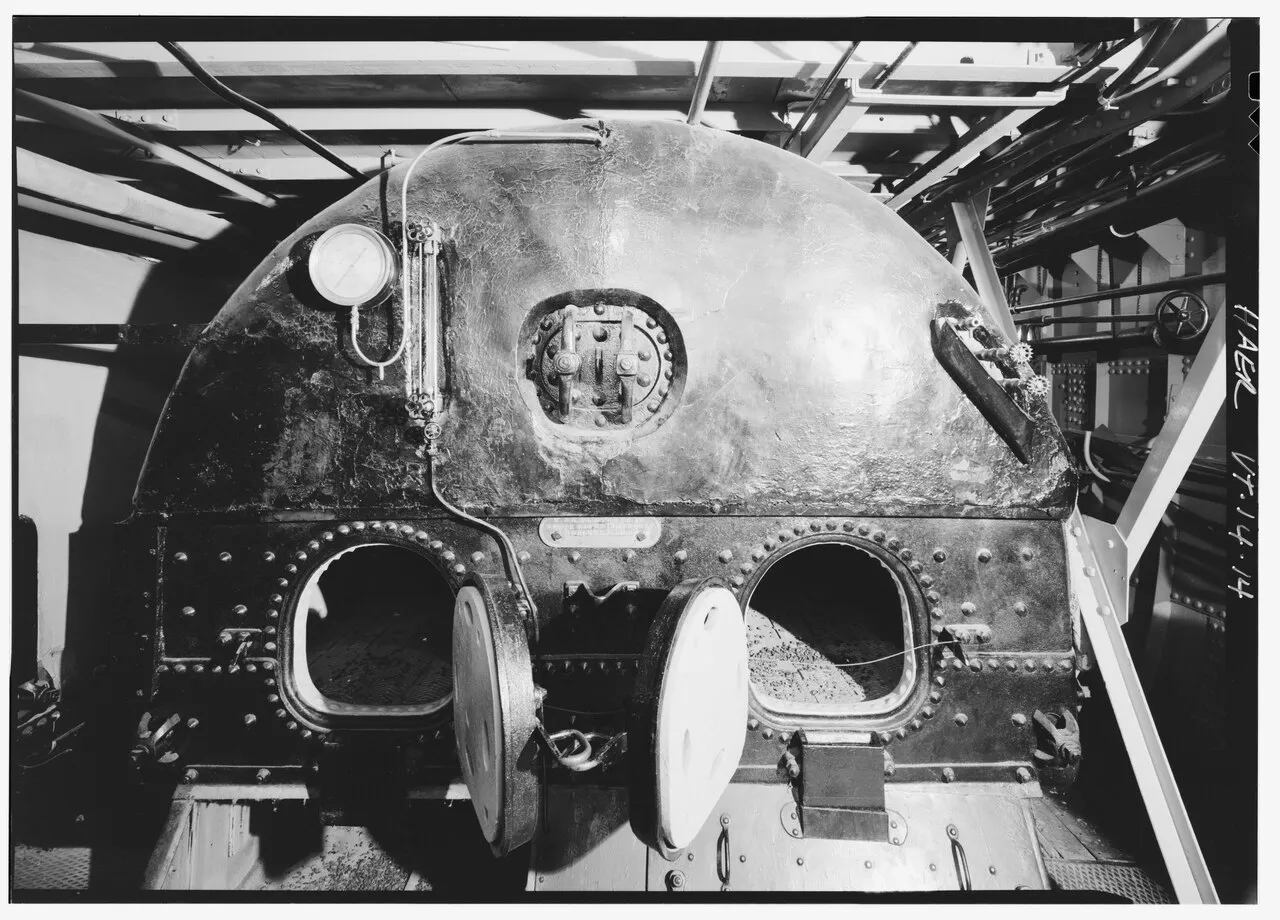
A large historic boiler. Home boilers are smaller, but the sight glass looks similar.
The pressure gauge
Both types have a gauge, but they read very differently. A steam gauge sits close to zero most of the time, at or just above half a psi when the boiler is running. A hot water boiler usually has a combined pressure and temperature gauge, and the pressure needle sits well above zero, because the system stays pressurised all the time. A reading near zero on a hot water boiler is a problem in itself, not a clue.
Radiator clues
The radiators can confirm what the boiler told you. A one-pipe steam radiator has a single pipe coming into it near the floor and a small air vent partway up the far end, often a little chrome or brass fitting that hisses as the system warms up. That hiss is air being pushed out of the radiator by the steam coming in behind it, and it stops once the vent closes.
Radiators with two pipes are less conclusive. Hot water radiators have a supply and a return, but so do radiators on a two-pipe steam system. Baseboards fed by pipes from the boiler, on the other hand, are almost always hot water. (Electric baseboards have no pipes and no boiler at all.)
When the clues disagree, or the boiler has been changed at some point and the piping tells a different story, read the nameplate on the boiler or the installation manual. It will say steam or water.
Older homes and boilers in New Jersey
A caveat first: we could not find a published count of how many homes in the state heat with steam versus hot water. What the Census does show is how old the housing is. In the American Community Survey 2024 1-year estimates (table B25034, year structure built), 657,940 of New Jersey’s 3,816,432 housing units were built in 1939 or earlier. That is about 17 percent. Add the 230,288 units built in the 1940s and it is roughly 23 percent, close to one home in four built before 1950.
The fuel picture is lopsided. The same survey’s house heating fuel table (B25040, 2024 1-year) counts 3,543,944 occupied homes in the state. About 74 percent heat mainly with utility gas and about 17 percent with electricity. Fuel oil and kerosene are down to 198,050 homes, under 6 percent. That table counts fuel, though, not equipment. A gas boiler and a gas furnace land in the same row, so it can’t say how many of those houses have radiators.
Those figures cover all homes, whatever heats them. Many older houses have had their original boilers replaced, converted or removed long ago. The age of a house is a reason to go and look at the boiler, nothing more.
What wears on each
Hot water: the circulator pump and the expansion tank
On a hot water system the parts that wear most are the ones that move or flex. The circulator pump runs every time there is a call for heat, and like any small motor it eventually fails. When it does, the boiler may still fire, but the heat never reaches the rooms.
The expansion tank is the quieter one. It gives the heated water room to expand. When a tank stops doing that job, pressure in the system swings more than it should, and the relief valve on the boiler may start to drip or discharge. A pressure gauge that climbs sharply every time the boiler runs is one of the signs to mention to whoever services it.
Steam: the water level controls
On steam, it’s the water level. Most of what goes wrong comes back to it.
A steam boiler boils off some water every cycle, and most of it comes back as condensate. Some does not. So the water level drifts, and it has to stay within a band the manufacturer sets. Inspectapedia is blunt about the far end of that: if the water level in the sight glass disappears completely, the boiler is unsafe, may already be damaged, and should be shut down.
That is why most steam boilers have a low water cutoff, a safety control that shuts the burner off when the water drops too low. Many also have an automatic water feeder that tops the boiler up. Both are worth knowing by sight.
When water keeps vanishing from the glass, Inspectapedia’s list of usual suspects is longer than most people expect: an automatic feeder that has stopped working, a failed check valve, clogged condensate return lines, a vacuum breaker that no longer works, or incorrect Hartford loop piping (a piping arrangement on the return that is there to keep the boiler from losing its water backwards if the return leaks). It also says the most common reason a low water cutoff fails to do its job is that it was never flushed through its blow-down valve as the manufacturer specifies.
The exact normal level is model-specific, so the boiler’s own manual is the reference, not a general rule of thumb.
On steam boiler maintenance generally: have a qualified technician check the low water cutoff and the controls each heating season, and follow the manual for anything the owner is expected to do between visits. If you are not sure what that is, ask before you open anything.
Can a steam system be converted to hot water?
Sometimes, but treat it as a redesign of the heating system rather than a boiler swap. HeatingHelp’s guide to converting from steam to hot water sets out why.
The radiators are the first hurdle. Steam radiators put out more heat per square foot than the same radiator filled with hot water. HeatingHelp puts it at 240 Btuh per square foot of radiation on steam and about 150 Btuh on hot water. A radiator that keeps a room warm on steam may fall short on hot water, and the only way to know is a complete and accurate heat loss calculation for the whole building, room by room. Rules of thumb do not answer this one.
Then there is the piping. A one-pipe steam system has a single pipe to each radiator, and a hot water loop needs a supply and a return, so a second pipe has to be run from the top of each radiator back to the boiler. On a two-pipe steam system the second pipe is already there, which is why HeatingHelp calls that conversion usually easier, while still advising a careful look at the system before deciding.
The oldest radiators can rule it out. HeatingHelp notes that the column radiators common before the 1920s often are not connected across the top between sections, and water will not flow well through them.
The finished hot water system also needs parts the steam system never had: a good air separator, a circulator sized from the heat loss calculation, and a correctly sized expansion tank.
What the heat loss calculation settles is room by room: whether each existing radiator, at hot water’s lower output, still covers that room’s loss on a cold day. Where one falls short, it needs replacing or supplementing, and every radiator on a one-pipe system still needs that second pipe. Add those up and you have the real size of the job.
For a radiator home that wants to move away from the boiler altogether, heat pumps are the other route worth reading about, since ductless units do not need ductwork the house never had.
Replacement options in general
A new boiler of the same type keeps the existing pipes and radiators. Changing type is the conversion job above.
Efficiency is where the two differ most. The Department of Energy’s Energy Saver guide to furnaces and boilers (archived copy of the page) says steam boilers operate at a higher temperature than hot water boilers and are inherently less efficient, while also noting that high-efficiency versions of all types are available. Efficiency is rated as AFUE, annual fuel utilization efficiency: the share of the fuel’s energy that becomes heat for the home over a typical year. An AFUE of 90 percent means 90 percent becomes heat and the other 10 percent escapes up the chimney and elsewhere.
Prices are a separate question, for the costs and planning guides. More on furnaces and boilers side by side is in the heating guides.
Questions about your heating system? Get in touch.