
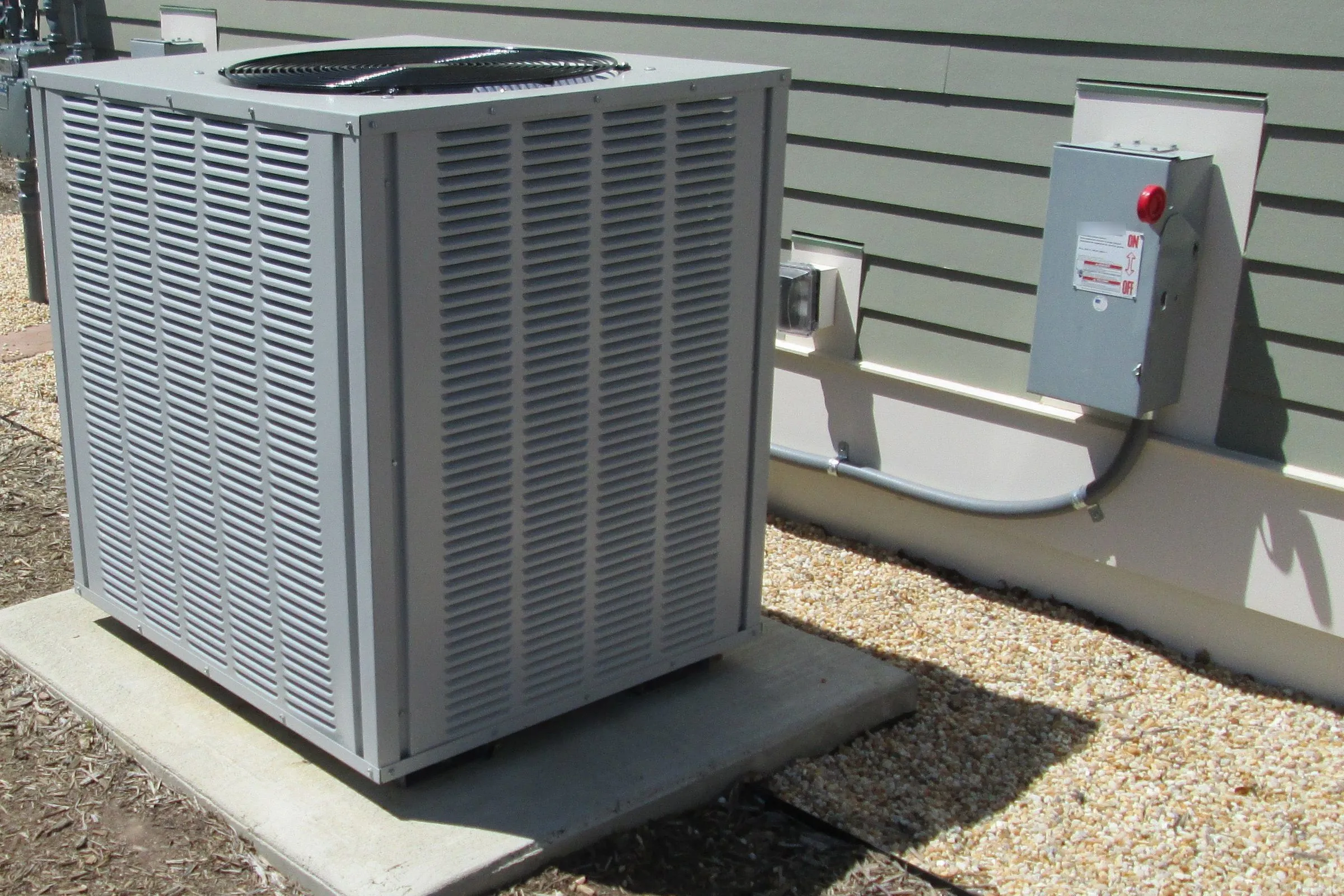
The box in the side yard won’t settle it. A heat pump’s outdoor unit and a central air conditioner’s condenser are built on the same pattern, a metal cabinet with coil on the sides and a fan on top, and from the lawn they look almost identical. What usually settles it is the label on that cabinet and the settings on your thermostat. Neither takes a tool, a ladder or more than a few minutes.
The short answer
You almost certainly have a heat pump if the outdoor unit’s efficiency label lists a heating rating (HSPF2) as well as a cooling one (SEER2), or if the outdoor fan is running while the house is being heated. An EM HEAT or AUX setting on the thermostat points the same way.
Everything below is done by looking. Leave the panels, the top grille and the electrical disconnect box alone; nothing here needs them opened.
How do I know if I have a heat pump? Start at the thermostat
It’s the easiest place to begin, because it’s already on your wall and you can read it in socks.
EM HEAT, EMER or AUX
Carrier’s own guide to spotting a heat pump says to look for an “EMER” (emergency heat) or “AUX” (auxiliary heat) setting, and adds that “a traditional furnace and air conditioning setup will not have these specific designations.”
Both labels exist because a heat pump usually has a second heat source behind it. Trane’s explainer on auxiliary heat describes aux heat as “supplementary heat to assist your heat pump in getting to the set temperature in your home,” switched on by the thermostat by itself. Emergency heat is the manual version, a setting that shuts the heat pump off and runs the backup alone.
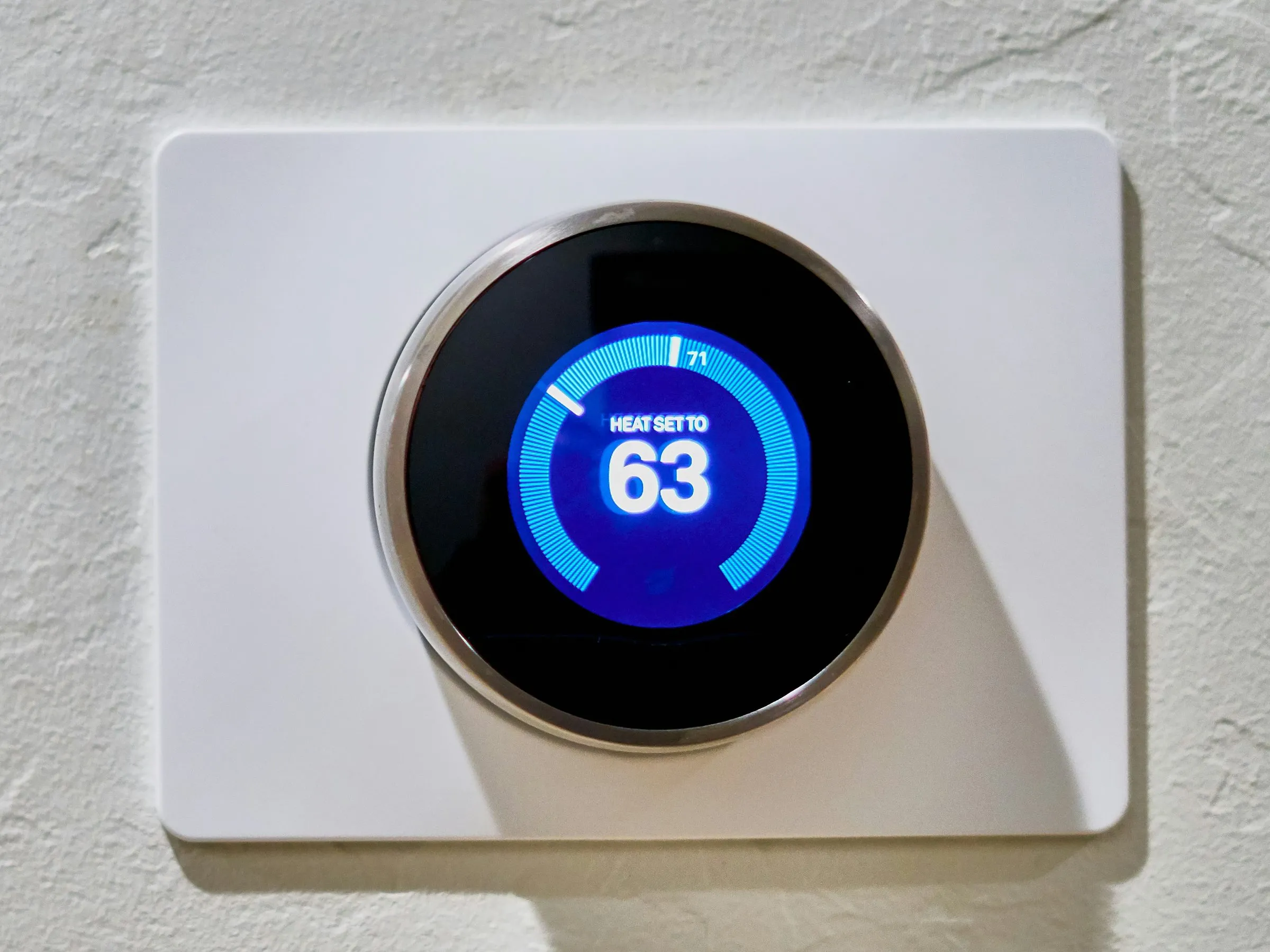
One caution. A missing label is a hint, not proof. Some thermostats tuck these options into an installer menu, and some only show “AUX” on the screen while backup heat is actually running, so a mild October afternoon may show you nothing at all. If the thermostat is inconclusive, go outside.
Read the label on the outdoor unit
This is the check we’d trust most, and it’s the one most people skip because the labels are small, faded or facing the fence.
The data plate and model number
Somewhere on the cabinet there’s a metal or foil data plate with the manufacturer, a model number and a serial number. Write the model number down exactly, dashes and all, and search it. The first result is usually the manufacturer’s spec sheet, which will say plainly whether the unit is a heat pump or an air conditioner.
Some brands build the answer into the number itself. Carrier says its heat pumps using R-410A refrigerant have model numbers that start with “25”, and the ones using R-454B start with “27”. That rule is Carrier’s alone, though. Other brands use their own codes, and there’s no single letter or prefix that means “heat pump” across every manufacturer, whatever a forum thread may tell you. When the search comes up empty, the manufacturer’s customer line can decode the number for you.
The efficiency label
Newer units usually also carry an energy guide label. Carrier’s rule of thumb here is simple: a heat pump lists both SEER2, its cooling efficiency, and HSPF2, its heating efficiency. “Air conditioners only display cooling efficiency metrics.” So a label with SEER2 and nothing about heating is an air conditioner.
Older units may show SEER and HSPF without the “2”. Those are the earlier versions of the same ratings, and the logic is the same.
How to tell if your AC is also a heat pump: watch it in winter
On a mild day in heating season, set the thermostat to heat and nudge it up a couple of degrees, then go look at the outdoor unit. Carrier puts it this way: “If the fan in the outdoor unit is running and blowing cold air out the top while your house is being heated, you have a heat pump.”
The cold air is the part that surprises people. A heat pump heats the house by pulling heat out of the outdoor air, so the air leaving the fan is colder than the air that went in. The part that lets the same machine run both ways is a reversing valve inside the cabinet (Carrier notes you can sometimes spot the brass valve through the top grille, but please don’t go hunting for it; the label tells you the same thing without putting your hands near a fan).
An air conditioner’s outdoor unit has no job in heating season. If yours sits still all winter while the house stays warm, the heat is coming from somewhere else. On a dual fuel system the heat pump also sits idle on the coldest days, when the furnace takes over, so check it on a milder day.
What does a heat pump look like?
Like a central air condenser. That’s the whole problem. Same box, same fan grille on top, same pair of copper lines running into the house.
Ductless systems are the exception that’s easy to spot: a slim unit mounted high on a wall inside, and a smaller, flatter outdoor unit with the fan on the front instead of the top.
Look at the equipment indoors
Follow the ductwork to the basement, attic or utility closet and see what it connects to.
An air handler is a tall cabinet with no flue pipe. In a heat pump system it often holds electric heat strips, which are the backup that AUX and EM HEAT switch on. A heat pump runs on electricity, so this kind of setup has no furnace flue serving the heating.
A furnace with a flue pipe running to a chimney or out through a wall burns gas or oil. That tells you where the house’s heat comes from, but not what the outdoor unit is. The outdoor unit could be a plain air conditioner, or it could be a heat pump in a dual fuel setup, where the furnace serves as the backup instead of heat strips. The outdoor label decides it.
Radiators, baseboard with hot water pipes, or a boiler in the basement usually mean the heat is handled by the boiler and any outdoor unit is there for cooling, or for a ductless system added later.
What your answer means
| Setup | Outdoor unit | How the house is heated | Most telling clue |
|---|---|---|---|
| Heat pump with electric backup | Heat pump | Heat pump, with heat strips in the air handler | HSPF2 on the label, no flue indoors |
| Dual fuel | Heat pump | Heat pump, gas furnace as backup | HSPF2 on the label and a furnace flue |
| Central AC and furnace | Air conditioner | Gas or oil furnace | SEER2 only; outdoor unit idle in winter |
| Central AC and boiler | Air conditioner, if there is one | Boiler and radiators or baseboard | Pipes to radiators, ducts only for cooling |
| Ductless mini-splits | Small outdoor unit, fan on the front | Wall units, often heating too | Check the label; varies by system |
The last two rows cover a lot of older houses in New Jersey, where a boiler was the original heat and ducts or wall units came later.
Why it matters which one you have
Mostly because of the thermostat. On a heat pump, EM HEAT is not a “very cold day” button. Trane says emergency heat is a setting “you should only use in a true emergency,” because selecting it “will shut down your heat pump and the auxiliary system will become the main heating system.” If the backup is electric heat strips, Trane says they use more energy than the heat pump. If it is a gas furnace, Trane says it may or may not cost more, depending on gas and electricity prices. People switch it on during a cold snap because the name sounds reassuring, and it’s the setting we’d most like new owners to leave alone.
The care list differs too. A heat pump’s outdoor unit works in both seasons, so it deserves the same attention in winter (clear of snow, leaves and anything stacked against it) that an air conditioner only needs in summer.
If you found a heat pump and wonder how it copes in January, read how heat pumps handle New Jersey winters. If you found central air and you’re weighing a switch, furnace vs heat pump costs and the heat pump rebates guide cover that decision. And if it turned out to be an air conditioner, how long central air lasts is probably the next question. There’s more on the equipment itself in the heat pumps hub.
Still not sure?
Take a clear photo of the outdoor data plate and one of the thermostat’s mode menu. Those two photos are enough for the manufacturer, or a qualified technician, to tell you what you have.
If you have a question about your own system, you can get in touch with our team.