
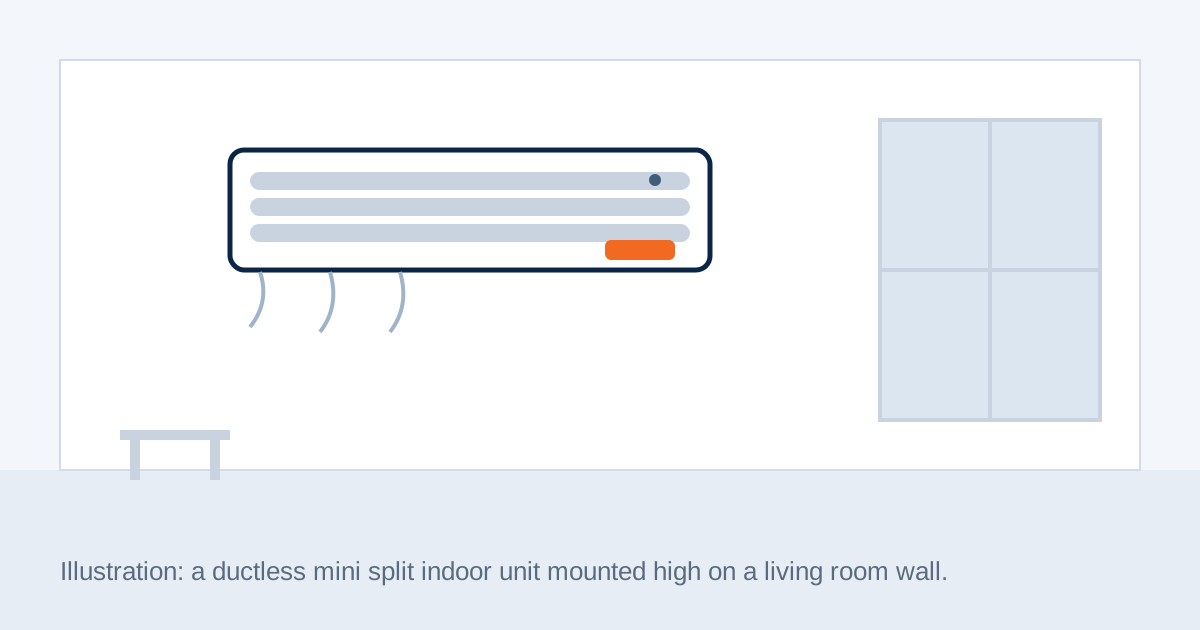
A mini split heats and cools one room at a time with no ductwork. Central air cools the whole house through ducts. If your home already has ducts, that’s a real choice between two good options. If it’s heated by a boiler and has radiators or baseboards, the question is really whether you want to build a duct system from scratch just to get cooling. ENERGY STAR lists older homes with radiators or baseboard heat and no ductwork as one of the places mini splits are increasingly used.
What is a mini split?
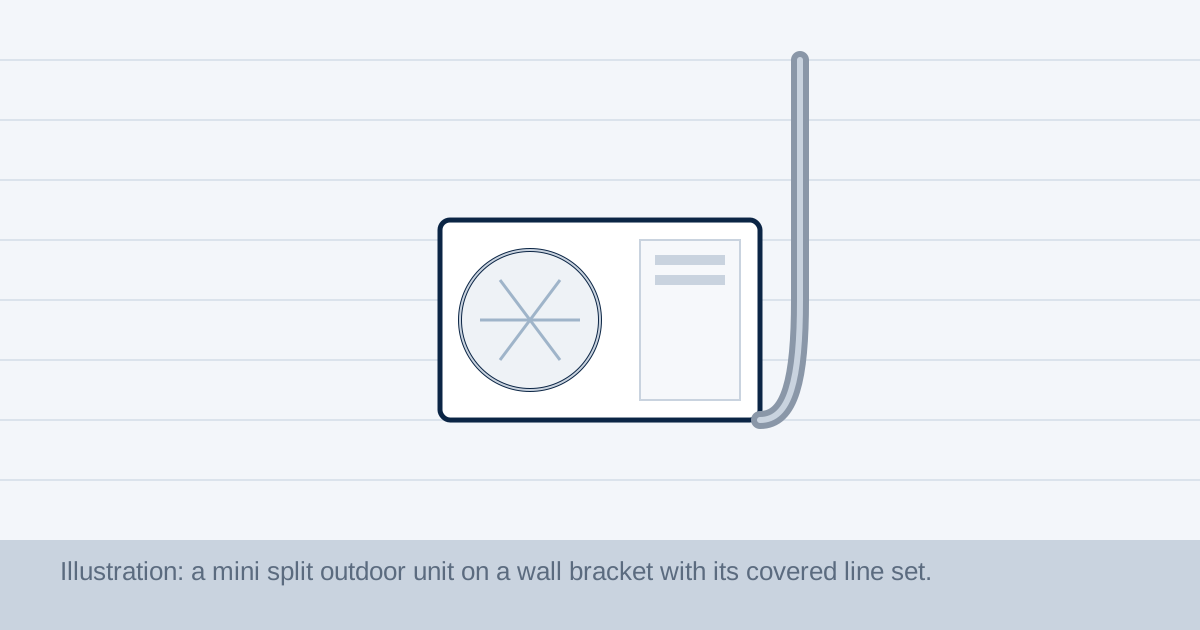
A mini split, or ductless mini split, is usually a heat pump in two parts. A compact outdoor unit sits on a pad or a wall bracket, and one or more indoor units hang high on a wall (sometimes set into the ceiling) in the rooms they serve. Two refrigerant pipes and a control cable run between them through one small hole in the wall. No ducts are involved in the usual wall-mounted kind: the indoor unit pulls room air across its coil and blows it straight back into the room.
It heats as well as cools. In summer it moves heat out of the room like an air conditioner; in winter the same cycle runs in reverse and pulls heat in from the outdoor air. So a mini split sold as a heat pump does both jobs, and the “split” in the name just means the machine is divided between inside and out. A window unit is the unsplit version of the same idea, with everything crammed into one box sitting in the window.
Mini split vs central air, compared
Ductless is more efficient and central air is invisible. Both are roughly true, and neither is what usually settles it. What the house already has does.
Upfront cost
A caveat first: installed prices for either system vary a lot from house to house, and published figures are national averages rather than local quotes.
For central air, the ducted side of the comparison is covered in what central AC replacement costs in New Jersey, with dated, sourced ranges. That article assumes the ducts are already there. Adding a new duct system to a house that has none is a separate, larger job, and its cost depends almost entirely on how hard it is to route ducts through that particular house, so we don’t put a number on it here.
For ductless, Filterbuy’s 2026 cost guide puts a single-zone mini split at $1,200 to $5,500 installed, a two-zone system at $4,000 to $9,000 and a five-zone system at $10,500 to $14,500 or more (Filterbuy, mini split installation cost, checked 2026-09-24; Filterbuy also sells mini split equipment). Those are third-party national numbers, not Greystone prices. Filterbuy adds that labor in the Northeast runs 25 to 40 percent above the national average, and New Jersey is in the Northeast. For more detail, see what a ductless mini split costs to install in New Jersey.
The pattern that matters: ductless is priced per room, roughly. Filterbuy puts four zones at $9,000 to $13,500 and five at $10,500 to $14,500 or more. That is the same territory as the $3,000 to $15,000 that Bryant and Carrier give for replacing central air on existing ducts, so a house that needs a lot of zones can end up paying as much for ductless as for central air.
Utility rebates can change the arithmetic for both systems, and the amounts change often enough that they live in their own article: New Jersey heat pump rebates.
Efficiency: are mini splits more efficient than central air?
Often, yes, but mostly because of the ducts rather than the equipment itself.
Central air makes cold air in one place and pushes it through ductwork, and ducts leak and pick up heat, especially when they run through a hot attic. ENERGY STAR’s fact sheet on mini split heat pumps says duct losses can account for more than 30% of a home’s energy use for space conditioning (ENERGY STAR, certified mini split heat pumps, 2024). A mini split has no ducts, so it skips that loss entirely.
Two more things push in ductless’s favor. ENERGY STAR certified mini splits use compressors and fans that can adjust their speed to save energy, instead of just switching on and off. And you only condition the rooms you’re using; nobody pays to cool a guest room that sits empty eleven months a year. Central air’s answer to that is closing vents, which works less well than people hope.
When you compare quotes, look at SEER2 for cooling on both, and HSPF2 for heating if the central system is a heat pump. The central AC article explains why the “2” matters when you’re reading old spec sheets.
Room-by-room comfort
Every indoor unit has its own thermostat, so the bedroom can sit at 68 while the kitchen runs warmer. That is the best thing about ductless, and in houses with a sunny upstairs and a cool first floor it’s the difference people notice most.
The limit is doors and walls. An indoor unit treats its own room well and the rooms beside it less well. A hallway, a bathroom or a small back bedroom with no unit of its own can end up stuffy. Central air, with a vent in every room, is more even across the house, even if it’s never perfectly even upstairs.
Looks and noise
The indoor unit is a long white box hung high on the wall, and some people simply don’t want one in the living room. It’s a fair objection. Ceiling cassettes, floor units and concealed ducted units exist for people who feel that way, and Filterbuy notes a ceiling cassette adds 1 to 3 hours of labor per zone.
Indoors, a mini split at low speed is quiet: a soft fan hum. A central air system is quiet at the vents but makes some air noise as it moves through the ducts, and both systems have an outdoor unit that makes some noise when it runs. Neither is loud in a way most households notice after the first week.
Maintenance
Every indoor unit has washable filters behind the front panel, and ENERGY STAR says to clean them when they look dirty or when the filter light comes on, so five zones means five sets of filters. Central air usually has one filter to change. (How often that one needs doing is its own question: how often to change your HVAC filter.) Both need the outdoor unit kept clear of leaves and snow, and both benefit from a periodic professional check, and in the mini split’s case that check includes cleaning the indoor coil and the blower wheel.
Homes without ducts: the boiler house
This is where the decision is least balanced.
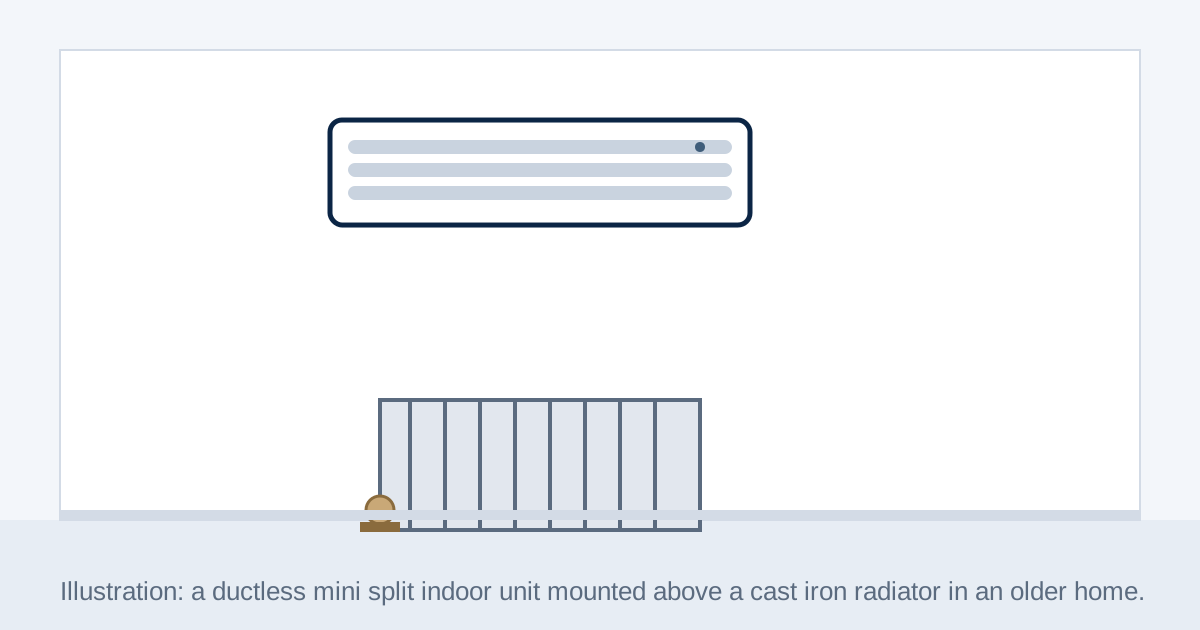
A house heated by a boiler moves its heat through water or steam pipes, not air. There’s no duct system and nothing to blow air through one. (If you’re not sure which kind of boiler you have, steam vs hot water boilers walks through how to tell.) To get central air, someone has to build all of that: an air handler, usually in the attic, supply ducts to every room, and at least one return. In a two-story house, reaching the first floor means running ducts down through closets or boxed-in chases in the corners of rooms, and in plaster-walled older houses every opening turns into a patching and painting job.
Some houses take it well. A single-story house with a roomy attic is the easy case. Many don’t: low attics, finished third floors, no good place for a chase, closets you’d rather keep as closets.
A mini split needs a small hole in an exterior wall for each indoor unit, a line set running outside, and an electrical circuit. That’s most of it. Most towns also want a permit for the work, so ask who pulls it. The boiler stays put and keeps heating the house through the winter the way it always has. The mini split adds cooling, and if it’s a heat pump, it can also take some or all of the heating load in spring and fall, when the boiler would otherwise fire up for a few hours to take the chill off.
Can the mini split replace the boiler entirely? Sometimes. A cold-climate model sized properly can heat most houses through most of a winter here, and do heat pumps work in New Jersey winters covers what the coldest nights actually ask of one. Whether it’s worth it on running cost is a separate calculation, set out in furnace vs heat pump cost. Plenty of owners keep the boiler as the main heat and see how the first winter goes.
One practical detail nobody mentions until the unit is up: the indoor unit makes condensate water in cooling season, and that water has to drain somewhere. Usually it goes out through the same wall hole with the refrigerant lines. When an indoor unit sits on an interior wall, a small condensate pump carries it out instead, and that pump is one more part that can hum or fail.
When central air still wins
If the house already has ducts in reasonable condition, a ducted system is usually the simpler answer. You’re replacing equipment, not building a system, and every room gets conditioned air. It doesn’t have to be a straight air conditioner, either: a ducted heat pump uses the same ducts and gives you heat as well as cooling.
Central air also makes sense in a gut renovation, where walls and ceilings are open anyway and ducts can go wherever they need to, and in a house with many small rooms that would each need their own ductless unit. And some people just don’t want equipment on the walls. That’s a legitimate reason, and it’s their house.
Whichever you pick, sizing it properly matters a lot. An oversized unit of either kind cools the air fast, leaves the humidity behind and short-cycles. The same load calculation drives both, and what size air conditioner you need explains how that works. There’s more on the cooling side in the cooling guides.
If you want to talk through which setup suits your house, you can get in touch with our team.