
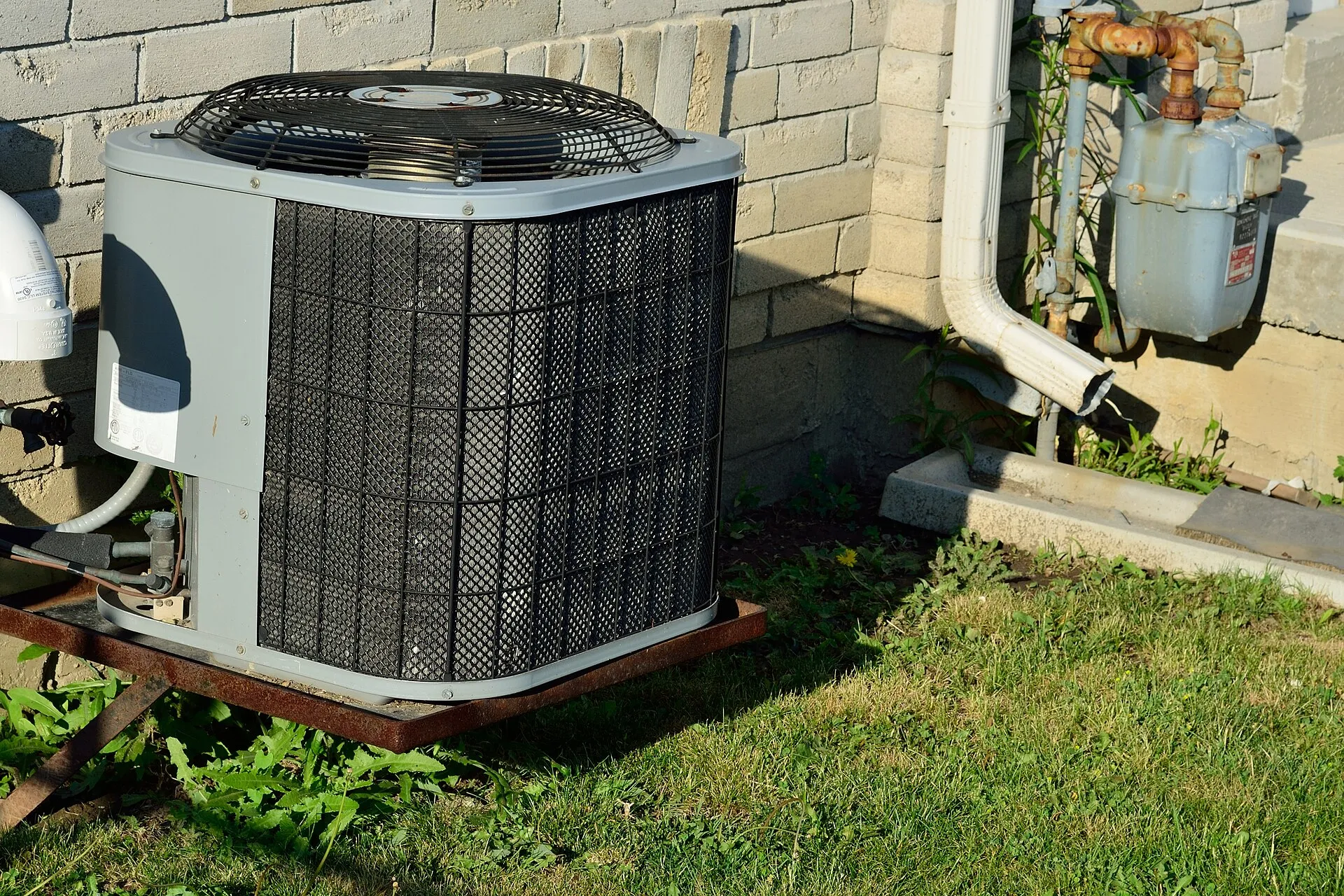
Somewhere on the outdoor unit of your air conditioner there’s a small label that names its refrigerant. On an older system it probably says R-22. On anything installed in the last fifteen years or so, R-410A is more likely. A new system quoted today will usually say R-454B or R-32.
Federal rules forced each of those changes, and each one leaves homeowners with the same two questions: do I have to do anything about the system I have, and what am I actually buying if I replace it? The short answer to the first is usually no. The second takes longer.
What refrigerant does
Refrigerant is the fluid that carries heat out of your house. It circulates in a sealed loop between the indoor coil and the outdoor unit. Inside, it soaks up heat as it evaporates. The compressor then pressurizes that vapor, and in the outdoor coil it gives the heat off and condenses back into a liquid. A working system doesn’t burn through refrigerant the way a car burns gas. If yours is low, it has a leak somewhere, and adding more without finding the leak just schedules the next visit.
Do heat pumps use Freon?
Yes, in the sense most people mean. “Freon” is a brand name that turned into a catch-all word for refrigerant, and a heat pump runs on the same kind of sealed refrigerant loop as a central air conditioner. It simply has a valve that lets it reverse the flow and pull heat into the house in winter. Heat pumps went through the same changes: older ones use R-22, many use R-410A, and new ones are built for R-454B or R-32. If you’re weighing a heat pump for the heating side too, our piece on whether heat pumps work in New Jersey winters covers that.
The timeline, from official sources
A caveat first. These rules have been revised more than once, the most recent change came in 2026, and states can add their own requirements on top. We’ve taken the dates below from the EPA where the EPA states them, and we checked them on September 24, 2026. Before you rely on one for a decision, look at the EPA’s page of HFC restrictions by sector for the current version.
| Date | What changed | Source |
|---|---|---|
| January 1, 2020 | No new R-22 (HCFC-22) made or imported in the U.S. | EPA |
| January 1, 2025 | New residential AC and heat pump systems limited to refrigerants with a global warming potential of 700 or less, which rules out R-410A | EPA |
| May 26, 2026 | EPA issues a final rule reconsidering parts of the 2023 rule | EPA fact sheet; Federal Register; NAHB |
| July 27, 2026 | That rule takes effect | NAHB |
R-22: the 2020 phase-out
R-22 contains chlorine, which damages the ozone layer. That’s why it was phased out, and why the phase-out ended with a hard stop: as of January 1, 2020, no new R-22 can be made or imported in the United States.
That did not make R-22 systems illegal to own or run. The EPA says plainly that people “can continue to use” equipment that runs on it, and that there is “no EPA requirement to convert existing HCFC-22 units.” What keeps those systems going now is R-22 that was recovered and reclaimed from old equipment, plus stock produced before 2020.
R-410A: the 2025 change
R-410A doesn’t touch the ozone layer, which is how it replaced R-22. Its problem is a high global warming potential. Under the AIM Act, the EPA set a limit of 700 for new residential air conditioners and heat pumps, starting with equipment made or imported from January 1, 2025. Under that 2023 rule, a split system built from components made or imported before 2025 could still be installed, but only until January 1, 2026. R-410A sits well above that limit. R-454B and R-32 sit below it, which is how they became the new refrigerants of 2025.
In 2026 the rule changed. The EPA’s May 2026 fact sheet says the final rule “removes the January 1, 2026, installation compliance date” for that pre-2025 equipment. The EPA’s sector page now says there is “no installation compliance date for systems where all specified components were manufactured or imported prior to January 1, 2025.” In plain terms, R-410A equipment built before 2025 can still be installed. NAHB, the home builders’ association, puts it as installation continuing “until existing supplies of these HVAC units are depleted.” Supply is shrinking in the background too. The AIM Act phases down production and consumption of HFCs as a group, R-410A among them, to 15% of their historic baseline levels by 2036, according to the EPA.
What it means for the system you have
If you have R-22
Nothing requires you to replace it. If it cools the house and isn’t leaking, it can keep running.
The trouble starts when it needs refrigerant. Every pound of R-22 that goes into a system now comes from a supply that nobody is adding to, and a leak that needs topping up every summer turns into a recurring cost with no end date. Be wary of paying for repeated recharges on an R-22 system. One recharge after a leak is found and fixed is a reasonable repair. A second one, the next year, usually means the leak wasn’t fixed.
Age matters too. R-22 went out of new equipment a long time ago, so almost any R-22 system still running is old by now.
Don’t read the refrigerant off the age of the house, though. New Jersey’s housing is old: the Census Bureau’s 2024 American Community Survey puts the median year built at 1971, and fewer than one home in ten was built in 2010 or later (table B25034). Central air in a house that age may have been added years after it was built, or replaced more than once since. The label on the outdoor unit is the only reliable answer.
Our guide to how long central air lasts goes through the signs that a system is near the end, whatever it runs on.
If you have R-410A
Keep it. A working R-410A system doesn’t have to be replaced, and nothing in the 2025 rules or the 2026 change says otherwise. R-410A is still produced under the phasedown, and technicians work on it every day. The production step-down will probably make it slowly more expensive over the next decade. How much, nobody can tell you yet, and anyone who gives you a confident number is guessing.
Why refrigerants cannot be mixed
Sooner or later someone asks whether they can put the new refrigerant into their old system, or the cheaper one into a system built for the other.
The answer is no, and the reasons are physical, not legal. Each refrigerant boils and condenses at different pressures. A system is built around one of them: the compressor, the metering device that controls flow into the coil, the oil in the system and the safety controls are all matched to it. Put in a different refrigerant and at best the system runs poorly. At worst the pressures are wrong for the parts.
It also rules out mixing. Top up a system with a different refrigerant and you get a blend that nobody designed, and it can’t be recovered and reused as either one.
For R-22, the EPA is direct: there are “no ‘drop in’ replacements for HCFC-22,” and alternatives “will not work well without making changes to system components.” R-410A in particular runs at much higher pressures than R-22, which is why the question “can you use 410A in an R-22 system” has the same answer every time.
The newer change works the same way. R-454B runs at pressures close to R-410A, which tempts people to assume the two are interchangeable. They aren’t. Carrier’s own page on R-454B says it “is not a drop-in replacement” and that “existing R-410A systems should not simply be charged with R-454B” (Carrier).
So a replacement you pictured as “just the outdoor unit” often turns into a matched outdoor unit and indoor coil, because the coil has to be built for the same refrigerant as the new condenser. The central AC replacement cost guide goes into what that does to the price.
(An aside, if you’ve ever wondered about the numbers. They aren’t model years. R-22 and R-32 are single chemical compounds, and the numbers encode their chemistry. Anything in the 400s, like R-410A and R-454B, is a blend of several compounds. R-454B is in fact partly R-32.)
Repair or replace
For an R-410A system, refrigerant alone is rarely a reason to replace. Decide on age, condition and the size of the repair, the same way you would have five years ago.
For R-22, the refrigerant pushes harder. A small repair that doesn’t involve the refrigerant circuit can still make sense. A refrigerant leak or a failed compressor is the point where it makes sense to get a replacement priced alongside the repair.
The new refrigerants: R-454B and R-32
What “A2L” means
Refrigerants get a safety class under ASHRAE Standard 34, a letter and a number. The letter is toxicity: A means lower toxicity. The number is flammability, and “2L” means lower flammability with a low burning velocity. AAON, an equipment maker, describes it as a refrigerant that, “in the unlikely event of ignition,” is “likely to burn slowly and self-extinguish” (AAON).
R-410A and R-22 are A1, which means no flame propagation. R-454B and R-32 are both A2L. That’s the real trade-off in the switch: a much lower climate impact, in exchange for a refrigerant that can burn under the right conditions.
That isn’t a reason to hold off on a new system. It is the reason the equipment and the installation rules changed.
The safety design that comes with it
Most of it you’ll never see. What you might see is a leak sensor. AAON says its R-454B units come with leak detection sensors as a standard feature, and Carrier describes a “refrigerant detection and dissipation system” on its R-454B equipment that can “detect a leak and activate a fan to help disperse refrigerant.” Other brands do something similar, and the details differ from one manufacturer to the next.
There are also rules about how much refrigerant a system can hold for the size of the room it serves, and about how installers handle and braze the lines. We won’t go deeper into the standards here. Those rules are for the installer to follow and for the inspector to check.
Questions to ask on a quote
Most of what matters on a replacement quote is covered in our guide to comparing HVAC quotes. For the refrigerant, a few questions are worth asking directly:
- Which refrigerant does the new system use? If it’s R-410A, ask when the equipment was made, and how the installer expects it to be serviced ten years from now.
- Is the indoor coil being replaced as well, and is it matched to the outdoor unit? Ask for the AHRI reference number for the pair.
- Is the line set being reused or replaced? If it’s reused, has it been checked?
- Does the equipment have a refrigerant leak sensor, and where is it mounted?
One more: who recovers the refrigerant from the old system? It has to be recovered, not vented, and it’s fair to see that on the quote.
If a rebate is part of your math, the refrigerant doesn’t change where to ask. New Jersey’s Clean Energy Program says “the state’s investor-owned electric and gas utilities” run their efficiency programs directly for customers, so the utility on your bill decides which models qualify. Our New Jersey heat pump rebates piece has the details.
An R-410A system on a quote at a lower price isn’t a trick. It’s legal to install, and it may be the right call for a house where the budget is tight. Get the answer to that servicing question in writing before signing. Our cooling guides cover the rest of the decision, from sizing to lifespan.
If you have a question about the refrigerant in your own system or on a quote you’ve been given, you can contact our team.