

If your house is heated by a boiler, there’s a good chance it has no ducts at all. Hot water or steam moves through pipes to radiators or baseboard, and nothing in the walls was ever built to carry air. That’s the whole problem with installing central air in a house without ducts: the cooling equipment is the easy part. Getting cold air to each room is where the money and the mess go.
It’s also why most answers to “how much to install central air” don’t fit your house. They assume the ducts are already there.
There are four realistic ways to do it. They overlap more on price than you might expect, and they differ a lot in how much of the house gets opened up.
Why so many boiler-heated homes have no ducts
A lot of older housing stock in the Northeast was built for hydronic heat, long before home air conditioning was common. Hot water and steam were the standard, and they need pipes, not ductwork. If you want the background on those two systems, our piece on steam vs hot water boilers covers it.
What it means today is simple. There’s no return air path, no trunk line in the basement, no registers in the floors, and there may be no obvious chase where a duct could run from the basement to the second floor. Any cooling system has to bring its own distribution, or skip distribution entirely.
It also means the boiler stays. None of the options below require you to change how the house is heated, although one of them (the heat pump) can take over some of that job if you want it to.
Air conditioning options for homes without ductwork
Before the numbers, a caveat. There aren’t many published cost figures for this exact situation, and the ones we could find are single-company figures from outside New Jersey, not surveys. One of them puts Northeast metro areas about 10 to 25 percent above its Midwest/Rust Belt baseline. We’ve dated and linked every one. Read them as a rough map, because a specific house can land well outside them.
New ductwork, usually with an attic air handler
This is the conventional route and, for a lot of two-story houses, the first one worth pricing. An air handler goes in the attic and feeds the upstairs rooms through short ceiling runs. The first floor is the hard part. Sometimes ducts can come up from the basement through closets or a stacked wall cavity; sometimes a second system is needed; sometimes the first floor ends up with a different solution altogether.
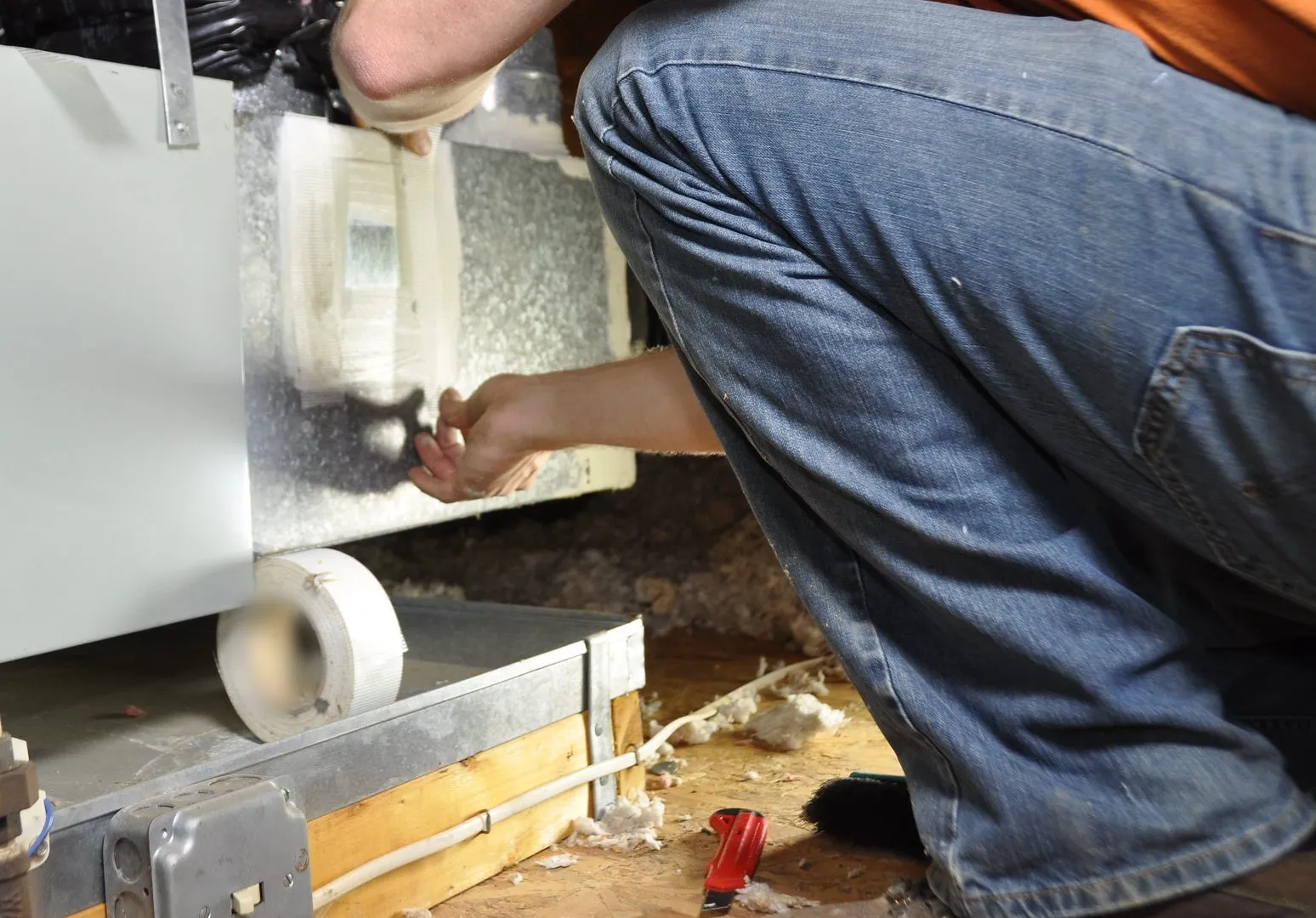
The reason to start here is capacity and simplicity. Full-size ducts move a lot of air quietly, the equipment is standard, and any service company knows how to work on it. The reason people walk away from it is the construction. Running full-size ducts through a finished house means cutting into ceilings and closets, and the attic ducts need to be well sealed and insulated, since an attic in July is the hottest place in the building.
So how much does it cost to install central air without ductwork this way? Smart Climate Solutions, a Pittsburgh-area contractor, published this breakdown in July 2025 (source):
| What | Published range |
|---|---|
| Most homes, no existing ductwork | $7,000 to $15,000 |
| Large homes, 2,500+ sq ft | $12,000 to $20,000 or more |
| 2,000 sq ft home: equipment | $3,000 to $5,000 |
| 2,000 sq ft home: ductwork | $3,500 to $6,500 |
| 2,000 sq ft home: labor and other | $1,500 to $3,000 |
The same page prices ductwork by the foot: $15 to $25 per linear foot for flexible duct and $25 to $40 for rigid sheet metal. That’s handy if a quote lists the ductwork as its own line. Its equipment figure for the 2,000 sq ft home also allows $500 to $1,200 for possible changes to an existing furnace or a new air handler. A boiler-heated house has no furnace to change, so for this option that line means the air handler.
High velocity central air (small-duct systems)
High-velocity systems, sold under brand names such as SpacePak, were more or less designed for houses like these. Instead of big rectangular ducts, they push air at higher speed through small flexible tubes. The Air-Conditioning, Heating and Refrigeration Institute describes the supply tubing as “2-inch insulated, flexible tubing” and says it’s popular in older homes “where conventional ductwork would require much more demolition” (AHRI). The tubes can snake through wall and floor cavities, which is the whole point.
A small aside: AHRI says the supply vents have “cover plates the size and shape of CD-ROMs (or smaller).” The comparison has aged, but the idea holds. You end up with a small round outlet in each room instead of a rectangular grille.
On high velocity air conditioning cost, Accelerate Net Zero published these installed ranges for SpacePak-style systems in May 2026 (source): most homeowners pay $6,000 to $18,000, with $6,000 to $8,500 for small homes, $9,000 to $13,000 for an average single-family home of 1,200 to 2,000 square feet, and $14,000 to $18,000 or more for larger or more complicated jobs. Those figures use a “Midwest/Rust Belt baseline,” and the same page puts Northeast metro areas about 10 to 25 percent higher “due to labor and permitting.”
Put that next to the conventional ductwork figures and the ranges overlap a lot, though the Smart Climate Solutions page puts high-velocity systems higher, at $12,000 to $20,000. We can’t tell you from here which one comes out cheaper in a given house. It depends on how much wall and ceiling each approach has to open, and that only shows up when someone walks the house. The real difference is how much of your plaster and trim you want disturbed. If that matters to you, a small-duct system is worth a serious look.
Ductless mini splits
Mini splits skip ducts completely. An outdoor unit connects through a small hole in the wall to one or more indoor heads, usually mounted high on a wall. The same Smart Climate Solutions page lists $3,000 to $8,000 for a single-zone system and $8,000 to $20,000 for multi-zone. Our guide to ductless mini split costs in New Jersey covers what drives the price. They’re the least invasive option by a wide margin, and one zone for the hottest bedroom is a reasonable way to start. The trade-off is that you see the indoor units, and a whole house with a head in every room adds up fast.
A ducted heat pump
A heat pump is an air conditioner that can also run in reverse to heat. Put in with ducts, it cools like central air and can share the heating load with the boiler on milder days. This Old House, updated August 2026, gives $10,575 as the average cost of a central heat pump including installation (source).
Be careful with that number. This Old House built it from Homewyse estimates and a 2026 survey of 1,000 homeowners who repaired or replaced their HVAC systems. It also says a home without existing ductwork may need a ductless mini split or a full duct installation, and that both increase labor and material costs. So in a house with no ducts, plan for the heat pump price plus the ductwork line from the conventional option above, not $10,575 on its own. If the boiler is also getting old, it’s worth getting this price next to a plain AC price. For New Jersey price ranges by type, see what a heat pump costs in New Jersey, and our heat pump guides explain how they work and when they fit.
What moves the price
House size is the obvious one, and the least interesting.
What surprises people is access. A walk-up attic with room to stand and a basement with open joists make almost any option cheaper, because the installer can run lines without opening finished surfaces. A house with a low-slope roof, no attic hatch, a finished basement and plaster throughout can push the same system toward the top of every range above. When two quotes on similar equipment are thousands of dollars apart, the gap can be in how each installer planned to get from the equipment to the rooms. Ask them to walk you through the route.
The number of floors and zones matters too. So does whether the electrical panel has room for another circuit.
Sizing sits outside this article, but it drives equipment cost directly. See what size air conditioner your home needs.
Disruption and timing
From least to most disruptive, the options rank roughly like this: mini splits, then high-velocity, then new ducts from an attic air handler to the upstairs only, then full new ductwork to every floor. A ducted heat pump is as disruptive as the ductwork it needs. It’s rough because houses vary. A high-velocity install in a house with awkward framing can mean more holes than a straightforward attic job.
Ask for the number of working days in writing, and which rooms will be affected on which days. Any patching of plaster or drywall should be clearly in or out of the quote, so you know who is paying for it.
On timing: demand for cooling work peaks once the heat arrives, so planning in the cooler months gives you more time to compare quotes. Permits are usually required for new equipment and ductwork. Your town’s building department can tell you what applies.
What to ask on a quote
The usual advice holds: get more than one quote and make sure each one prices the same job. Our guide on how to compare HVAC quotes goes through it line by line. For a no-ducts house, a few questions matter more than usual:
- How does air get to each floor, and where exactly do the ducts or tubes run?
- Does the price include opening and patching walls and ceilings, or only the HVAC work?
- Was the system sized with a load calculation for this house?
- For a high-velocity system, how many outlets, and where?
- Is the attic equipment (if any) on a drain pan with a safety switch?
That last one is easy to overlook. An air handler above a finished ceiling that overflows its condensate drain leaves a stain you’ll be looking at for years.
Related reading
If your house already has ducts and an aging system, that’s a different job: see what central AC replacement costs. More on prices and planning is in the costs and planning hub, and the cooling guides cover the rest of the topic.
If you’d like to ask about your own house, you can contact our team.